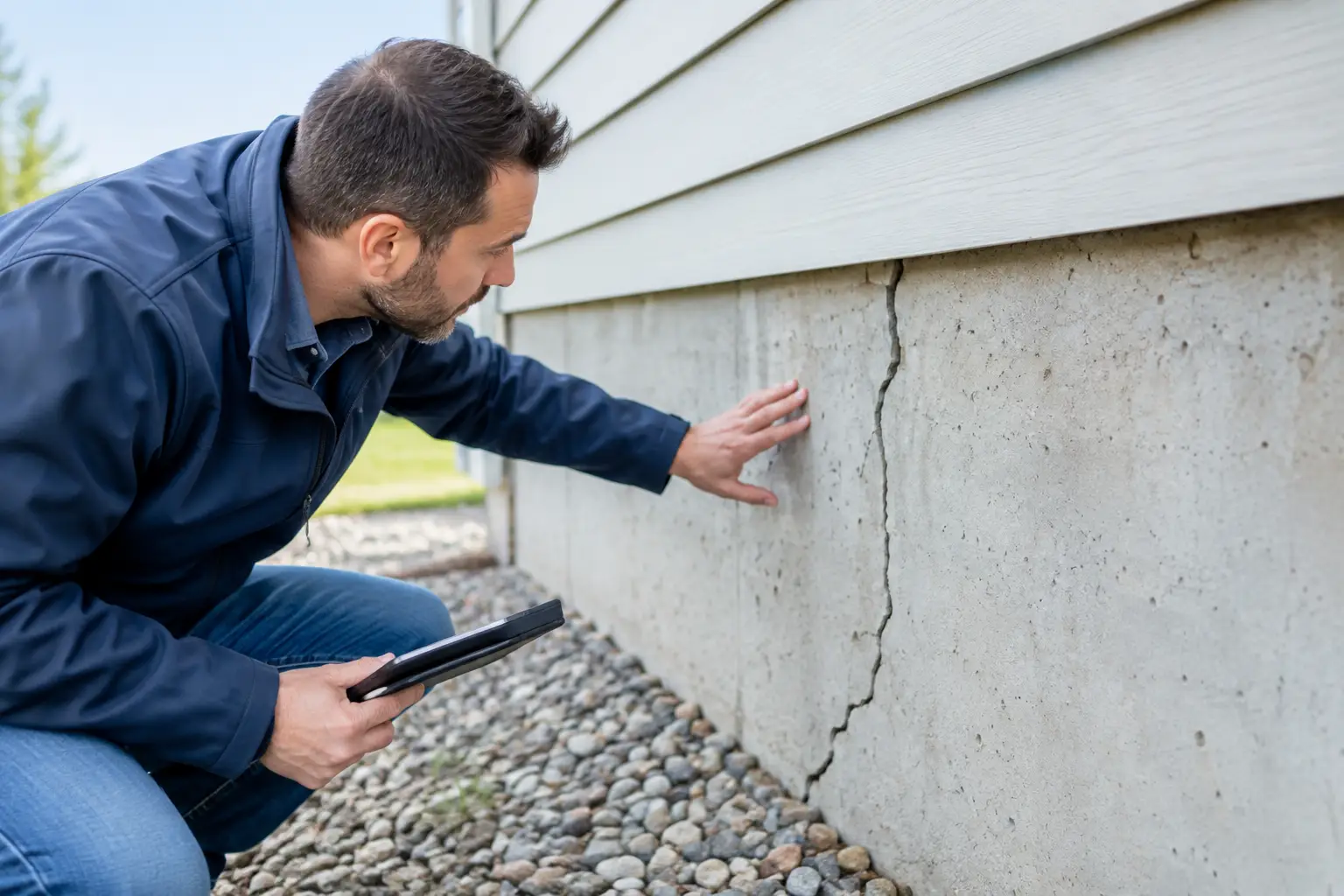
A fresh coat of paint can hide a crack for a viewing, but it cannot stop movement in the building behind it. For buyers and owners in Portugal, knowing how to assess foundation cracks means separating ordinary aging from evidence that a property may need specialist investigation, structural work, or a revised renovation budget.
A crack is not a diagnosis. Older homes, particularly stone, brick, and rendered masonry properties, commonly show cracking from settlement, seasonal moisture changes, past repairs, and decades of alteration. The question is not simply whether a crack exists. The question is what pattern it follows, whether it is active, and what other evidence supports or contradicts a structural concern.
How to Assess Foundation Cracks Systematically
Start by treating the crack as one item in a wider property assessment. A wall crack may originate from foundation movement, but it can also result from failed render, roof movement, thermal expansion, poor-quality repairs, plumbing leaks, or changes to openings such as doors and windows.
First, identify where the crack appears. Cracks at the base of an external wall, around corners, beside windows, or at the junction between an original building and an extension deserve closer attention. The same applies to internal cracks that continue through multiple rooms or align with cracking visible outside.
Then observe its shape and direction. Fine, irregular surface cracking in render often points to a finish-layer issue. A diagonal crack running from the corner of a window or door toward the ground can be more significant, especially if it is wide, stepped through masonry joints, or repeated on both sides of a wall. Vertical cracks may be less concerning in some situations, but their location, width, and relation to building movement still matter.
Measure rather than guess. Record the widest point in millimeters, take clear photographs with a scale reference, and note the date. Look for displacement too: one side of a crack sitting proud of the other is more concerning than a flat crack of similar width. If the crack has been filled and reopened, that is useful evidence of continuing movement, although it does not prove the foundation is the cause.
Finally, look beyond the wall. Doors that bind, windows that no longer close squarely, sloping floors, separated skirting boards, cracked tiles, and gaps between walls and ceilings can all add context. One isolated hairline crack may be cosmetic. A cluster of related symptoms requires a more cautious view.
Read the Pattern, Not Just the Width
Width provides a useful first filter, but it should never be the only criterion. A very fine crack can still matter if it is new, lengthening, or accompanied by distortion. A wider crack may be historic and stable if it has remained unchanged for years and shows no associated movement.
As a practical guide, hairline cracks under roughly 1 millimeter are often associated with plaster, paint, or render shrinkage. Cracks around 1 to 5 millimeters should be assessed in context, particularly where they are diagonal, stepped, or visible both internally and externally. Cracks wider than 5 millimeters, cracks with visible offset, or cracks that are clearly growing should be treated as a material risk until properly investigated.
There are exceptions. Traditional Portuguese buildings often use thick masonry walls, lime-based renders, and materials that respond differently to moisture and temperature than modern framed construction. A repaired crack in a century-old stone property may be entirely manageable. Equally, a newly renovated house can conceal movement behind crisp finishes. Age alone does not make a crack safe or dangerous.
Cracks that often require closer investigation
Certain patterns justify a higher level of caution, particularly before purchase or major renovation:
- Diagonal or stepped cracks extending from window and door corners.
- Cracks that pass through masonry units rather than only the render surface.
- Open cracks with one side visibly displaced from the other.
- Recurrent cracks after recent filling, plastering, or painting.
- Cracking combined with sticking doors, uneven floors, or separated extensions.
- Cracks near drains, downpipes, retaining walls, slopes, or large trees.
These signs do not automatically mean that underpinning or major structural work is needed. They mean the cost of making assumptions is too high. The next step is to establish the mechanism of movement.
Check Water, Ground Conditions, and Building Alterations
Foundations respond to what happens above and below ground. Water is frequently part of the story. Failed gutters, leaking downpipes, poor surface drainage, damaged underground pipes, or ground that slopes toward the house can soften soil, wash out fine material, or create repeated wet-dry cycles around the foundations.
During an inspection, check whether roof water is controlled and discharged away from the building. Look for staining at downpipes, standing water near walls, eroded soil, damp lower courses, and signs of leaking drainage. On properties with wells, septic systems, retaining walls, or terraced land, the relationship between water and ground conditions deserves particular attention.
Also consider changes to the building. An extension built against an older structure, a removed internal wall, a new heavy roof covering, excavation for a basement, or a nearby swimming pool can alter how loads and ground conditions behave. Cracks at the junction between old and new construction are common, but they should not be dismissed as normal without checking whether the separation is stable and appropriately detailed.
Portugal also has areas with sloping terrain, variable soils, coastal exposure, and a history of piecemeal building alterations. A visual assessment should account for the setting, not apply a generic rule to every property.
Distinguish Cosmetic Damage From Structural Risk
Cosmetic cracking is generally limited to finishes. It may appear as fine crazing in paint, shallow cracking in render, or small plaster cracks caused by drying and minor material movement. It is usually localized, has no displacement, and is not accompanied by functional problems in doors, windows, floors, or the building envelope.
Potentially structural cracking tends to show a more coherent pattern. It may run diagonally through openings, continue from outside to inside, affect multiple levels, or be associated with visible distortion. It can also occur where a wall is carrying load, where an extension joins the main house, or where ground levels and drainage conditions create additional risk.
The trade-off is straightforward: opening up finishes or commissioning a structural assessment costs money, but overlooking active movement can expose a buyer to far larger costs after completion. Before committing to a purchase, uncertainty should be priced, investigated, or reflected in the conditions of the deal.
Document What You Find Before Any Repair
Do not repair a suspect crack immediately if you need to understand whether it is active. Photograph it in good light, include a ruler or crack gauge, and record the room or elevation, direction, approximate width, and nearby symptoms. Repeat the photographs over time from the same position.
For a property you already own, simple monitoring may be appropriate where the crack is minor and there is no evidence of rapid movement. A professional may install tell-tales or recommend more formal monitoring where the cause is unclear. Monitoring is most useful when it is paired with an inspection of drainage, roof discharge, nearby vegetation, soil conditions, and the building’s structural layout.
For a buyer, time is usually limited. That makes a structured pre-purchase assessment more valuable than informal monitoring alone. The aim is not to provide false certainty from a single visit. It is to identify the level of risk, determine what further investigation is proportionate, and estimate the possible impact on renovation scope and cost.
When to Call a Structural Professional
Arrange further professional investigation promptly if a crack is wide, visibly displaced, expanding, or linked to floor movement, door and window distortion, or persistent water issues. The same applies if there is cracking in retaining walls, signs of ground movement on a slope, or evidence that previous structural repairs have failed.
A qualified inspector can document the condition and identify likely mechanisms. Where necessary, a structural engineer can advise on load paths, foundation performance, opening-up works, monitoring, drainage corrections, stabilization, or repair design. The correct remedy depends on the cause. Filling a crack before resolving a leaking drain, for example, may only produce another crack and another invoice.
At Quantum EcoBuild, the focus is on facts, not assumptions: identify the evidence, understand the risk, and plan the next decision before construction money is committed.
A foundation crack should not automatically end a purchase or trigger expensive work. It should prompt the right questions. When the pattern, surrounding conditions, and building behavior are assessed together, you can move forward with a clearer view of what the property needs and what it may truly cost.
Leave a Reply