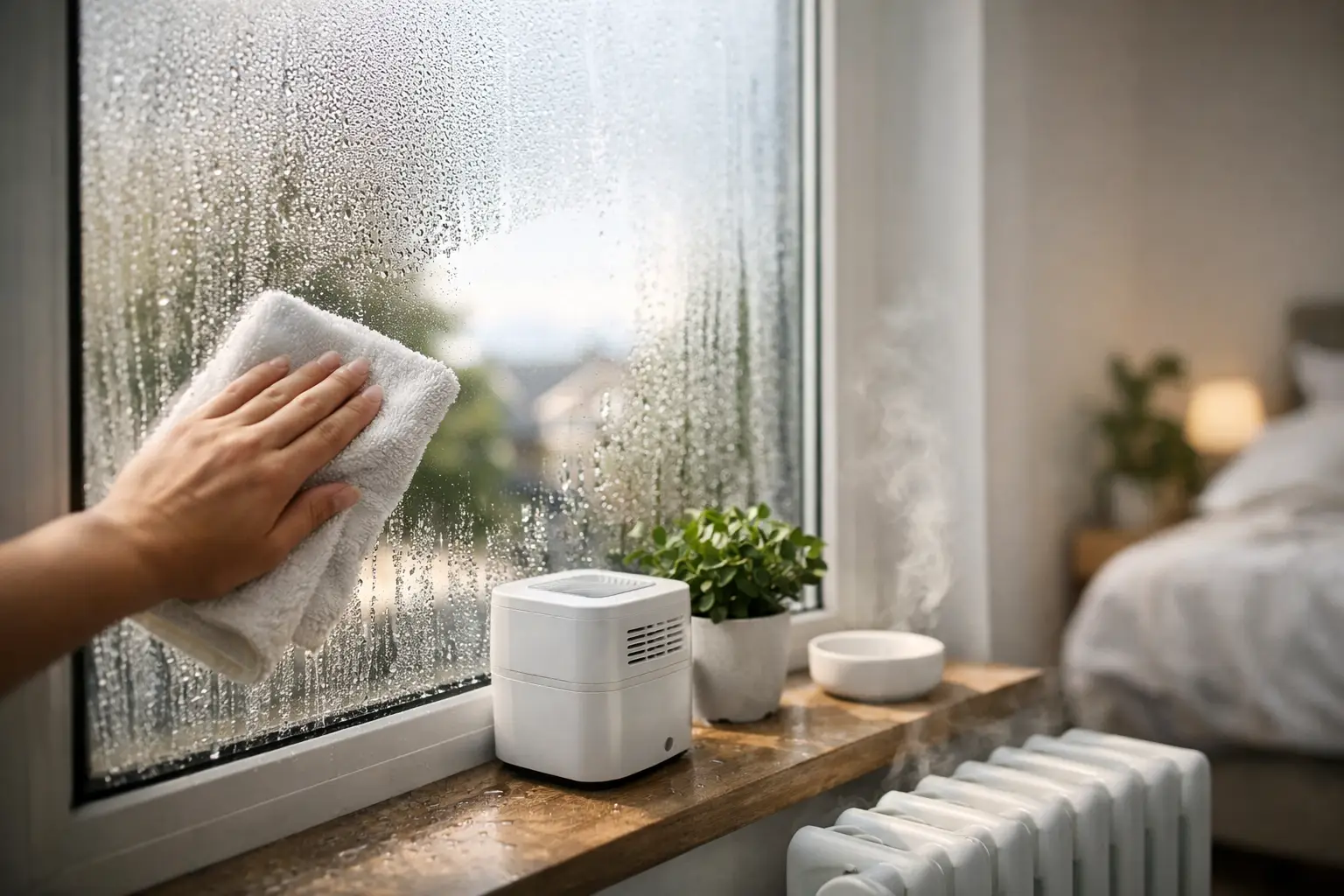
A misted bedroom window on a cold morning may look minor, but repeated condensation can be an early warning of a bigger moisture problem. The best ways to reduce condensation are not limited to wiping glass or buying a dehumidifier. They start with understanding where moisture is being produced, why it cannot escape, and whether the building fabric is cold enough for water vapor to settle on surfaces.
For homeowners, buyers, and investors in Portugal, this distinction matters. Condensation can encourage mold growth, damage finishes, affect indoor air quality, and conceal thermal defects. It is also commonly confused with rain penetration, plumbing leaks, or rising damp – problems that require very different repairs.
First, confirm that it is condensation
Condensation occurs when warm, moisture-laden air meets a surface that is colder than the air’s dew point. The water vapor becomes liquid water, usually on windows, exterior-facing walls, metal frames, corners, and behind furniture.
The pattern provides useful clues. Condensation is often worse in winter, first thing in the morning, after showers, or following cooking and drying laundry indoors. It may appear across several rooms, particularly bedrooms and bathrooms. Mold from condensation commonly forms in cold corners, around window reveals, behind wardrobes, and near ceilings.
By contrast, a damp patch that worsens after heavy rain may point to a roof, façade, flashing, gutter, or window-seal defect. A concentrated stain below a bathroom or kitchen may be a plumbing issue. Moisture rising consistently from the bottom of a ground-floor wall calls for further investigation rather than assumptions.
Before spending money on treatments, identify the moisture source. A moisture meter, thermal imaging survey, inspection of the roof and external envelope, and a review of ventilation can help separate a condensation problem from water entering the building. Painting over staining without this step may only hide the evidence temporarily.
The best ways to reduce condensation: control moisture and cold surfaces
Condensation needs two conditions: excess humidity indoors and surfaces cold enough to collect it. Effective improvements address one or, preferably, both.
Ventilate where moisture is created
Bathrooms and kitchens need purposeful extraction, not just an occasionally opened window. Use an extractor fan during showers and cooking, then leave it running for at least 15 to 20 minutes afterward. A fan that vents into an attic, cavity, or enclosed ceiling space is not a solution – it transfers moisture to a place where it may damage timber or create hidden mold.
Where possible, choose humidity-controlled or timer-controlled extraction. These systems respond more reliably than household habits, especially in rental properties or homes that are occupied intermittently. Check that exterior grilles are clear and that duct runs are not crushed, excessively long, or poorly installed.
Opening windows briefly can help, particularly after showering or cooking. However, relying on open windows alone is not always practical in a humid coastal climate, during cold weather, or in homes near traffic and noise. Controlled mechanical extraction is generally more dependable.
Reduce everyday moisture production
A typical household produces significant moisture through showering, cooking, breathing, and drying clothes. You cannot eliminate these activities, but you can prevent moisture from spreading through the property.
Keep bathroom and kitchen doors closed while generating steam. Use pan lids and run the cooker hood when cooking. If the hood recirculates air through a charcoal filter, it may reduce odors and grease but does not remove water vapor as effectively as a ducted system that exhausts outdoors.
Drying laundry indoors is one of the most common contributors to winter condensation. Dry clothes outside when conditions allow, use a vented or condenser dryer correctly, or keep an internal drying area isolated and mechanically ventilated. A dehumidifier can help in this room, but it should support good ventilation rather than replace it.
Maintain steady, sensible heating
Cold walls, ceilings, and windows collect condensation more readily. Intermittent heating – allowing a home to become very cold and then heating it rapidly for a few hours – can worsen the difference between warm indoor air and cold building surfaces.
A lower, steadier background temperature is often more effective for moisture control and comfort. The right setting depends on occupancy, insulation, energy costs, and the heating system, but the objective is clear: avoid persistently cold internal surfaces.
Heating alone will not resolve high humidity. In fact, warming air without removing moisture can make a room feel temporarily better while leaving the underlying humidity load unchanged. Heating, ventilation, and insulation must be considered together.
Improve insulation and remove thermal bridges
A thermal bridge is a section of the building that loses heat faster than the surrounding construction. Common examples include uninsulated concrete beams, slab edges, metal window frames, poorly insulated roof junctions, and corners where external walls meet.
These areas can become cold enough for condensation even when the rest of the room appears dry. Repeated mold in the same corner or around the same window is a strong reason to investigate thermal bridging.
Insulating a roof, external wall, or exposed floor can raise internal surface temperatures and reduce risk. The detail matters as much as the insulation itself. Poorly designed internal insulation can trap moisture within a wall or create new cold junctions at reveals and partitions. For older Portuguese properties, especially stone, masonry, or solid-wall buildings, material selection and vapor behavior should be assessed before work begins.
Upgrade windows as part of the whole system
Single glazing and older aluminum frames can be major cold surfaces. Double glazing, thermally broken frames, improved seals, and correctly installed window surrounds can significantly reduce window condensation and improve comfort.
But replacement windows are not an automatic cure. Older homes often relied on leaky frames for background air movement. Installing airtight new windows without adding planned ventilation can trap more humidity indoors. If windows are upgraded, consider trickle vents where appropriate, extract ventilation in wet rooms, and the condition of surrounding walls and insulation.
Use a dehumidifier intelligently
A dehumidifier is useful when a property has seasonal humidity, drying laundry indoors, limited ventilation options, or a temporary moisture burden after renovation. It can lower relative humidity and help dry the air while permanent improvements are planned.
It is not, however, proof that the problem has been solved. If a unit needs to run constantly to prevent mold, the building may have inadequate extraction, poor insulation, an external water ingress issue, or an occupancy pattern that needs adjustment.
Aim to keep indoor relative humidity broadly around 40% to 60%. A simple hygrometer provides more useful information than judging the air by feel. Readings consistently above 60% in cooler months justify further investigation, especially if windows are wet each morning or mold is returning.
Check the building envelope before renovating
For buyers and owners planning renovation, condensation should be assessed before cosmetic work begins. Fresh paint, new flooring, or fitted wardrobes can conceal cold surfaces and reduce access to visible clues. If the property also has roof defects, failed render, cracked façade joints, or leaking gutters, fixing ventilation alone will not protect it.
A structured property assessment should review roof drainage, façade condition, window installation, ventilation routes, insulation continuity, heating provision, and moisture patterns inside the home. Thermal imaging can be particularly useful in suitable weather conditions because it helps identify cold zones and likely thermal bridges. It should be interpreted alongside visual inspection and moisture measurements, not used as a standalone diagnosis.
For vacant properties, consider how the home will be used after purchase. A building that stayed dry with windows open year-round may behave differently when occupied full-time, heated in winter, and sealed with new windows. This is a common renovation risk: improving one part of the building without planning for the effect on the whole system.
When condensation needs professional investigation
Seek technical advice when mold returns after cleaning and ventilation changes, when damp patches do not follow a clear condensation pattern, or when you are planning insulation and window upgrades. Investigation is also sensible before buying a property with musty odors, extensive black mold, peeling paint, swollen timber, or unexplained staining.
The cost of a proper diagnosis is usually small compared with replacing finishes, treating mold repeatedly, or carrying out insulation work that creates new moisture risks. Quantum EcoBuild approaches these cases by looking at the evidence – the building fabric, moisture source, ventilation, and intended renovation scope – rather than prescribing a generic product.
Condensation is manageable when the cause is clear. Start by measuring humidity, observing where and when moisture appears, and separating everyday condensation from water entering the structure. That evidence gives you a practical basis for repairs that protect both the property and the people living in it.
Leave a Reply