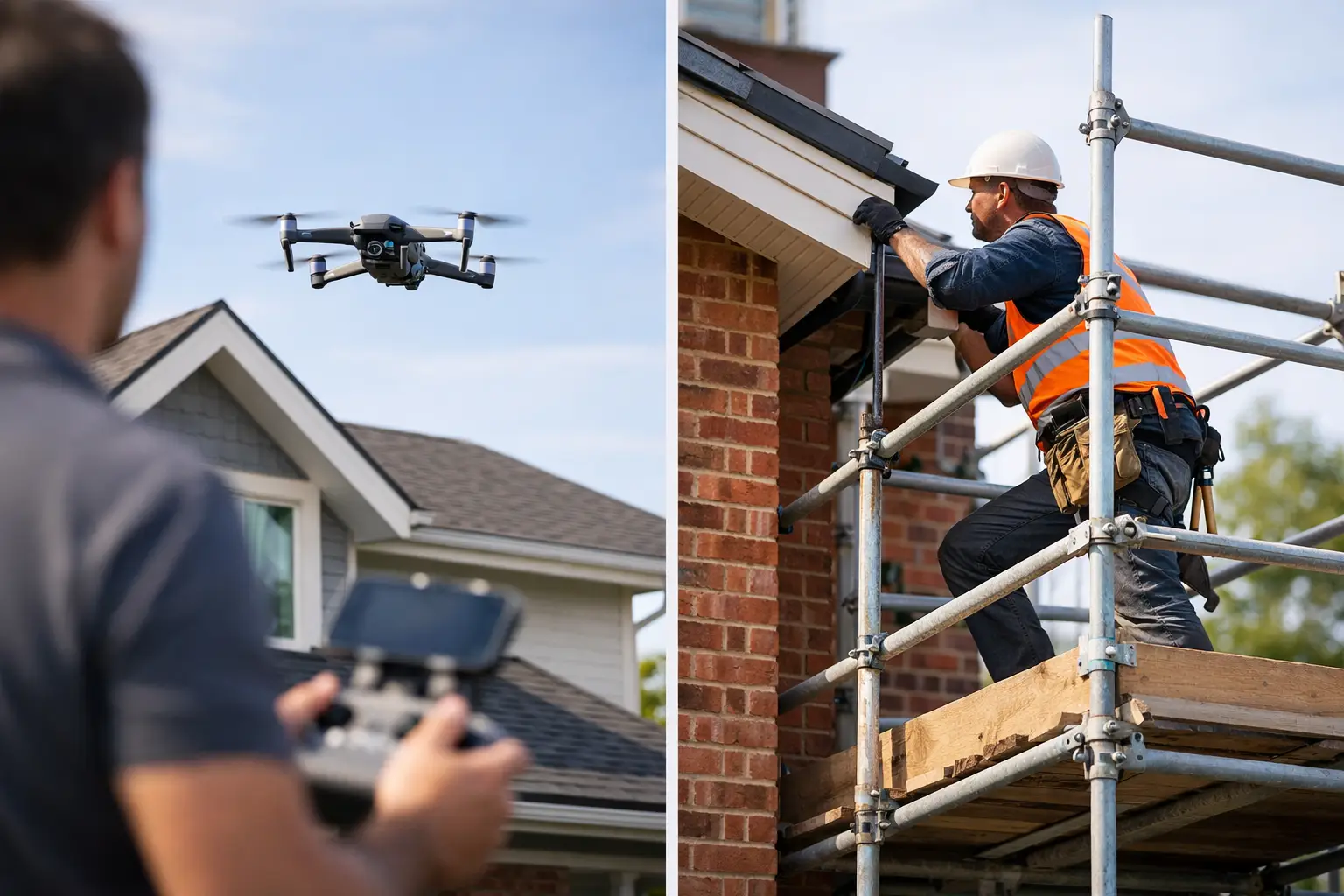
A roof can look sound from a garden gate and still conceal broken tiles, failed flashings, deteriorated chimneys, and moisture entry points. For buyers and owners, the question of drone inspection vs scaffolding is not simply about choosing the cheaper access method. It is about getting enough reliable evidence to make the right decision before committing to a purchase, repair budget, or major renovation.
In Portugal, this decision matters especially on older properties, hillside homes, village houses with restricted access, and buildings with traditional clay-tile roofs. Each access method has a clear role. The mistake is treating either one as a complete answer in every situation.
Drone Inspection vs Scaffolding: The Core Difference
A drone inspection is a visual survey from the air. It can capture high-resolution images and video of roof planes, ridges, gutters, valleys, chimneys, façades, solar panels, and other elevated elements without putting a person on the roof. It is fast, non-invasive, and particularly useful when access is difficult or when a property is being evaluated before purchase.
Scaffolding is a physical access system. It allows inspectors, roofers, engineers, and contractors to work close to a building, touch materials, test details, take measurements, and carry out repairs. It takes longer to arrange and costs more, but it is essential when visual evidence indicates a defect that requires hands-on confirmation or repair.
The practical distinction is simple: a drone shows what is visible from close range; scaffolding allows investigation and work. A drone can identify slipped tiles and suspect flashing. It cannot confirm the condition of timber beneath the tile, assess the firmness of a parapet by hand, or replace a failed section of guttering.
Analyze: Start With the Decision You Need to Make
The right method depends first on why you are inspecting the property. A pre-purchase assessment has different requirements from a roof repair scope or a full renovation plan.
For a buyer, drone imagery can provide valuable early evidence. It may reveal uneven roof lines, vegetation in gutters, damaged chimney caps, patch repairs, cracked render at high level, or signs that water is not draining correctly. These findings can affect negotiations, contingency planning, and the decision to proceed. They also help prevent a common problem: assuming that a roof is acceptable because no issue was visible from ground level.
For an owner planning maintenance, a drone inspection can establish whether scaffolding is justified before the expense is incurred. If the roof is visually consistent and no defects are apparent, the next step may be limited maintenance or monitoring. If imagery shows multiple displaced tiles, open ridge sections, deteriorating mortar, or extensive staining, a contractor can prepare a more informed access and repair plan.
When the objective is to execute repairs, scaffolding is often unavoidable. A roofer needs stable, safe access to lift tiles, inspect underlay, repair flashing, renew mortar, and test the completed work. The useful question is not whether scaffolding can be avoided at all costs. It is whether it should be installed before there is sufficient evidence of the work required.
Understand What Each Method Can and Cannot Prove
Drone imagery is highly effective for visible external condition. It can document the overall geometry of a roof, identify localized damage, and create a record that can be compared over time. It also reduces the need for an initial roof walk, which can be unsafe and can damage older tiles that are already fragile.
This is particularly valuable on Portuguese homes where roof access may be awkward. Narrow streets, internal courtyards, steep plots, mature trees, and neighboring structures can make ladders or traditional access equipment impractical. Scaffolding may also require coordination where it occupies a sidewalk, affects a shared wall, or requires permission within a condominium arrangement.
However, drone footage has limits. Shadows can conceal defects. A camera cannot see beneath tiles or behind render. It cannot determine whether a roof structure has adequate strength, whether a small crack is active, or whether moisture has penetrated into the insulation and ceilings below. Image quality also depends on weather, light, flight position, and the operator’s ability to capture the relevant details.
Scaffolding provides the proximity required for a more conclusive inspection. An experienced professional can test whether mortar is loose, inspect lead or other flashing details, assess the condition of timber at exposed areas, and measure components accurately. If repairs are needed, the team is already in position to perform them safely.
Yet scaffolding is not automatically more informative in the early stage. Installing it around an entire building before establishing where the problems are can increase cost, delay decisions, and create disruption for occupants and neighbors. On a property with several roof sections, drone imagery may show that only one area needs close access, reducing the eventual scaffold footprint and repair scope.
Plan: Compare Cost, Safety, and Disruption
Cost is usually the first concern, but it should be viewed alongside the risk of incomplete information. A drone inspection generally costs substantially less than erecting scaffolding because it does not involve transport, assembly, permits, long rental periods, or labor-intensive dismantling. It can often be completed quickly, making it useful during a short purchase due-diligence window.
Scaffolding costs vary significantly with height, site access, building shape, duration, and local requirements. A simple two-story façade is very different from a multi-level home on a steep plot. If the scaffold extends onto public space, additional coordination may be required. These costs may be justified when work is confirmed, but they can be premature when the scope is still uncertain.
Safety changes the calculation as well. A professionally operated drone removes much of the immediate fall risk associated with preliminary roof inspection. It also avoids sending someone onto brittle tiles or unstable roof surfaces before their condition is understood.
For hands-on work, properly installed scaffolding is generally safer than repeated ladder access. It gives workers a stable platform and provides a controlled way to move materials. It does not eliminate risk, but it is usually the appropriate method for substantial repairs, detailed high-level façade work, or long-duration projects.
Disruption matters to owners and investors, too. A drone survey may take a short visit and leave no physical trace. Scaffolding can affect access, views, security, daylight, and daily use of the property for days or weeks. If a house is occupied, rented, or located in a dense historic area, those practical effects should be planned rather than treated as an afterthought.
Execute: Use a Staged Inspection Strategy
For many properties, the strongest approach is staged rather than either-or. Begin with a ground-level review of accessible areas, interior signs of moisture, drainage, ceilings, walls, and visible roof edges. Then use drone imagery to inspect areas that cannot be safely or reliably assessed from the ground.
The findings should be interpreted in context. A single cracked tile may be a contained maintenance issue. Repeated tile displacement along a ridge, staining below a chimney, and vegetation-filled gutters together may indicate a broader water-management problem. A good assessment separates confirmed defects, likely risks, and items that need closer investigation.
Scaffolding becomes the next step when the evidence supports it: when repairs are clearly needed, when a defect cannot be confirmed visually, or when an engineer or contractor needs direct access to define the work. At that point, the access system is supporting a known purpose rather than being used to search blindly for one.
For major renovation projects, drone survey data can also support planning before work begins. It helps document the existing roof and exterior condition, identify access challenges, and communicate priorities clearly to contractors. Once scaffolding is in place, close inspection can refine the repair scope and reveal hidden conditions that should be included in the budget contingency.
When Scaffolding Should Come First
There are cases where starting with a drone is not appropriate. If a roof is visibly unstable, has suffered storm damage, presents an immediate public-safety risk, or is already scheduled for full replacement, the priority is to secure the area and arrange safe physical access. A drone may still help document the condition, but it should not delay urgent action.
The same applies when the concern is structural rather than visual. Significant sagging, active water ingress, major cracks, or movement in a chimney may require an engineer and close inspection. Technology improves visibility. It does not replace professional judgment or direct investigation where the consequences of failure are high.
For homeowners and buyers, the practical goal is not to choose the newest tool or the most traditional method. It is to obtain evidence in the right sequence, spend money where it reduces risk, and avoid making a major property decision based on a view from the ground. Know what the roof is telling you before you ask anyone to price the repair.
Leave a Reply