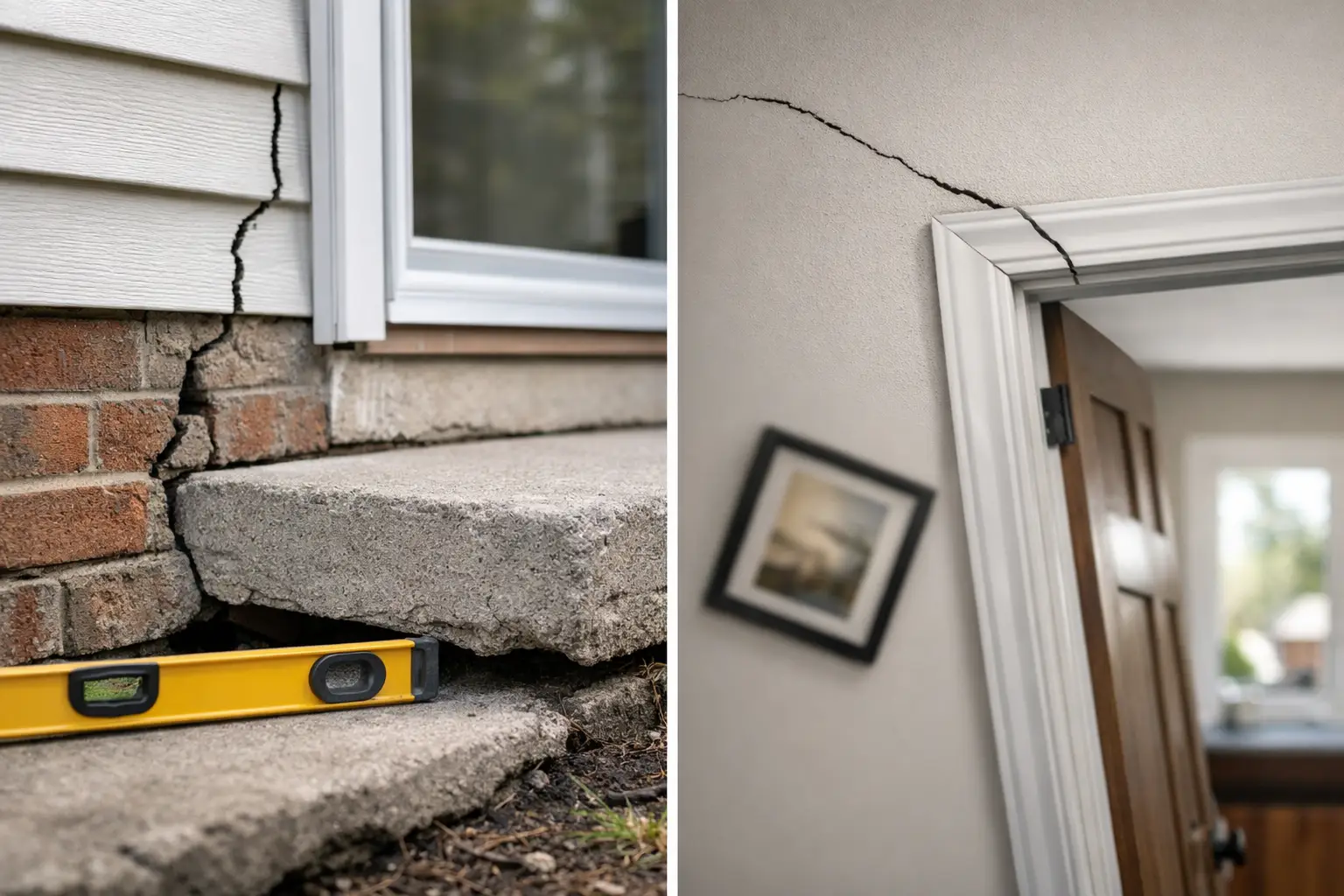
A hairline crack in an old Portuguese stone wall is not automatically a structural emergency. A stepped crack that widens from floor to ceiling, catches a window frame, and reappears after repair is a different matter. The best signs of foundation movement are rarely one isolated defect. They are patterns that show the building is moving unevenly and that the movement may still be active.
For buyers, owners, and investors, the practical question is not simply, “Is there a crack?” It is whether the defect is cosmetic, historic and stable, or evidence of a problem that could affect safety, renovation scope, insurance, resale value, and cost. We focus on facts, not assumptions.
What Foundation Movement Actually Means
Foundation movement occurs when a building settles, heaves, shifts, or rotates because the ground supporting it changes or because part of the structure no longer carries loads as intended. In older properties, some degree of historic settlement is common. Buildings constructed in stages may also show cracks where old and newer sections meet.
Movement becomes more concerning when it is differential. This means one section moves more than another. That uneven movement puts masonry, plaster, openings, roofs, and service connections under stress. The visible crack may be the symptom, not the cause.
In Portugal, risk can vary significantly by location and construction type. A rural stone house on sloping ground, a coastal property exposed to drainage issues, and a rendered masonry home with later extensions can each fail in different ways. Clay soils that shrink and swell, poorly managed surface water, leaking drains, erosion, tree roots, excavations nearby, and inadequate foundations can all contribute.
The Best Signs of Foundation Movement to Watch For
Diagonal or stepped cracks in masonry
Diagonal cracks running from the corners of doors or windows are among the most useful visible indicators. In blockwork or brickwork, they often follow mortar joints in a stepped pattern. This can happen because openings are natural weak points where movement concentrates.
A crack deserves closer assessment when it is wider at one end, continues through both internal and external walls, or is clearly opening rather than simply visible in paint. Fresh, sharp crack edges, broken render around the crack, and repeated patch repairs are also relevant clues.
Cracks alone do not confirm foundation failure. Thermal movement, minor plaster shrinkage, and normal aging can cause superficial cracking. The concern rises when crack direction, location, and other defects point to the same movement pattern.
Doors and windows that bind or no longer align
Doors that suddenly rub the floor, windows that jam, and frames that appear out of square can indicate distortion in the walls around them. Check whether the issue is local or widespread. A single swollen timber door in a damp bathroom is often a moisture or joinery issue. Several sticking doors and misaligned windows across the property deserve more attention.
Look at the gaps around frames. Uneven gaps, cracked plaster at the corners, and windows that will not latch may indicate that the opening has changed shape. In a viewing, do not accept “old houses are like that” as a diagnosis. It may be true, but it should be verified.
Sloping floors and noticeable changes in level
A floor that slopes toward one side of a room can result from settlement, decayed joists, poor historic alterations, or simply an old construction method. The cause matters. A timber floor may feel uneven because its structure has deteriorated, while a concrete slab may slope due to subsoil movement or poor original construction.
Use a level or laser measurement rather than judging by eye alone. A modern survey can map floor levels across the building and identify whether a change is isolated or part of a broader tilt. LiDAR scanning is particularly useful for recording geometry accurately before renovation work starts.
Separation between building elements
Gaps where walls meet ceilings, skirting boards, terraces, chimneys, or later extensions can reveal that connected elements are moving differently. Pay close attention to an extension joined to an older main house. A narrow, consistent joint may be an intentional movement joint. An irregular gap with cracking and displaced finishes may not be.
External clues can be just as revealing. A terrace pulling away from the house, cracked paving beside a wall, detached steps, or a chimney leaning relative to the roofline may point to localized ground or structural movement. These observations need to be assessed in context, especially where drainage directs water toward the building.
Cracks that return after repair
Fresh paint and newly filled cracks can make a property appear well maintained while concealing an unresolved issue. Ask when repairs were completed and whether cracks have returned. Recurrent cracking is not proof of serious movement, but it is a reason to investigate rather than rely on the finish.
Photographs from previous years, renovation invoices, and older listing images can help establish a timeline. If the property has been patched repeatedly without identifying the cause, budget uncertainty remains. Cosmetic repair before diagnosis is often false economy.
Look Beyond the Walls for the Cause
Foundation movement is often connected to water. Gutters that overflow beside a wall, downspouts discharging at the base of the house, broken drainage pipes, and ground that falls toward the building can soften or wash out supporting soil. On a slope, uncontrolled runoff can create a more serious risk than the crack itself suggests.
Inspect the roof drainage system, external ground levels, retaining walls, and visible drains. Signs such as persistent damp at the base of walls, erosion channels, standing water, or vegetation growing from damaged drainage runs should not be treated as separate maintenance items. They may be part of the same mechanism.
Trees also require judgment. Roots can influence moisture levels in certain soils, but removing a mature tree without professional advice can cause further soil change. The appropriate response depends on tree species, distance from the property, soil type, foundation depth, and whether the movement is active.
How to Distinguish Historic Settlement From Active Movement
A stable historic crack can often remain visible without requiring major structural work. It may be weathered, previously repaired successfully, and unchanged over years. The surrounding walls, openings, and floors may show no related distortion. Older homes are not expected to look newly built, particularly where traditional lime render and stone masonry are involved.
Active movement is more likely when defects are fresh, expanding, seasonal, or accompanied by new operational problems in doors and windows. It is also more concerning when cracks appear on both sides of a wall, affect structural masonry rather than only plaster, or occur after heavy rain, drought, excavation, or nearby construction.
Monitoring can provide evidence. Crack gauges, dated photographs taken from the same position, and periodic level surveys can show whether dimensions change over time. Monitoring is valuable when the building is safe and the cause is uncertain. It is not a substitute for prompt professional input where there is significant displacement, a visibly leaning wall, or a risk to occupants.
What to Do Before You Buy or Renovate
Do not make a purchase decision from a cosmetic viewing alone. If you see several of the best signs of foundation movement, treat them as a due diligence issue and obtain an independent property assessment. The objective is to define the defect, its likely cause, its extent, and the sensible next step.
A useful assessment should consider the full building: wall cracks, floor levels, roof structure, drainage, ground conditions, past alterations, and the relationship between original construction and additions. Where needed, this may lead to targeted investigation by a structural engineer, such as opening up concealed areas, surveying levels, checking drains, or reviewing soil conditions.
The repair strategy should follow the diagnosis. Improving drainage may solve the underlying driver in one property. Another may need localized masonry repair, rebuilding of a retaining element, structural ties, underpinning, or a redesigned extension connection. Underpinning is not the automatic answer and should never be presented as one without evidence.
For a renovation, record the building’s existing condition before demolition starts. This protects you from confusing old defects with contractor-related damage and gives the project team a factual baseline. Quantum EcoBuild uses practical site knowledge and digital survey methods to help clients understand that baseline before money is committed.
A property with movement is not always a property to walk away from. The decision depends on cause, severity, repairability, budget, and the level of risk you are prepared to carry. The right next step is simple: establish what is moving, why it is moving, and whether the proposed solution addresses the cause rather than just the crack.
Leave a Reply